THE ANGEVIN EMPIRE
  • About
  • Localities
  • Sources
  • Course Info
  • Podcasts

Sources of Angevin History

​

The Miracles of Thomas Becket

11/20/2018

 
Picture
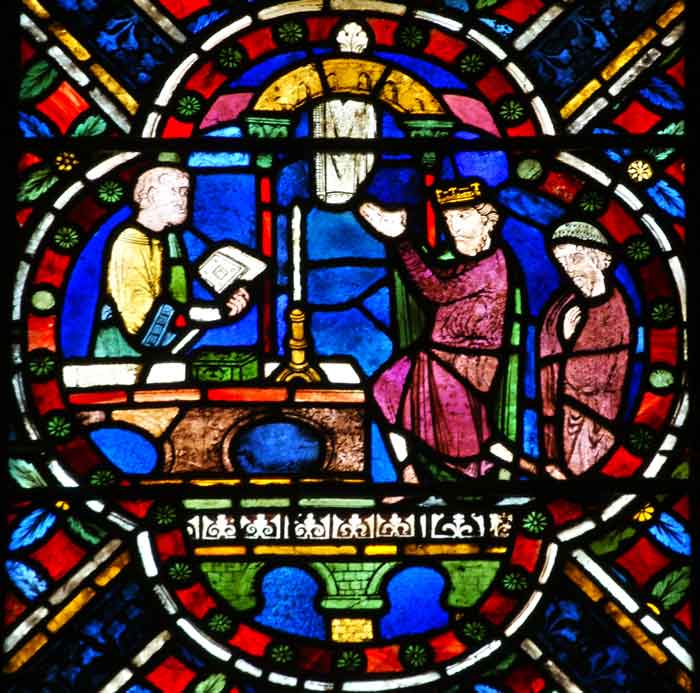
King Henry II does penance at the tomb of St. Thomas Becket. Canterbury Cathedral 
By John Evans
​Description 
According Marcus Bull, were recorded by Benedict of Peterborough and William of Canterbury at Canterbury on the grounds of the shrine of St. Thomas, in front of the tomb or reliquary where Becket’s remains were preserved.  The sex, appearance,  place of origin, and social status of the pilgrims were recorded. Often they would answer a series of questions that would unravel the fullness of their stories. The miracles they encountered usually occurred elsewhere and the pilgrims would almost always end up as the stars of their own account. Unlike hagiography or historiography writing, miracle collections are not usually bound by chronology, but are usually thematically driven. Benedict’s miracle collection seems to have survived in more manuscripts, leading Bull to conclude it was the preferred version, whereas Staunton presents William’s miracle collection as the official version. ​We know that Benedict was more Biblical and localized in his scope whereas William could often be snobbish in his disdainful description of the poor.  Book I of Williams’s writings was most likely presented to Henry II’s court.
​Relevance to Angevin History 
​As Marcus Bull explains, William of Canterbury blatantly seems to reject Henry II’s invasion of Ireland as an unjust war throughout his collection stretching the norms even of the genre in which he is writing. However, if Bull is correct, Book I of the collection seems to present Henry II in a much more positive light, even depicting his victory over the rebellion of 1173/ 1174 as a direct response to a visit to the relics of the holy martyr. Nevertheless, on the whole William presents the royal figure in a negative light. Wielding a series of classical references and displaying a wide range of learning, William’s version of the Miracles is a clear indictment of Henry’s overreaching policies, in matters temporal and spiritual. Benedict, in my own opinion seems to do the same through the symbolism of the elder tree and Diocletian’s coin. This sentiment is seemingly supported indirectly by Bull when he explains why William’s text was sent to Henry rather than Benedicts. He makes the claim that Benedict had already a less than favorable relationship with the king. Whether this is true or not, it is clear that the miracle collections of Thomas Becket, by both William of Canterbury and Benedict of Peterborough depict struggles within the Angevin Empire between Henry’s attempts to maintain dominance over his vast empire and a clerical body seeking to critique these missuses of temporal authority. Yes, there were clerics on either side of the Becket affair, and yes there were even clergy who supported Henry’s invasion of Ireland. However the fact that Becket‘s oppositional stance was ultimately canonized coupled with   the miracle collection’s concerns over due-reverence, lead me to identify William and Benedict’s authorial voice with clerical anxieties over royal power.

Comments are closed.

This website is managed by
​Dr. Nicholas Paul
Director of Medieval Studies
Associate Professor of History
Fordham University 
Proudly powered by Weebly
  • About
  • Localities
  • Sources
  • Course Info
  • Podcasts